
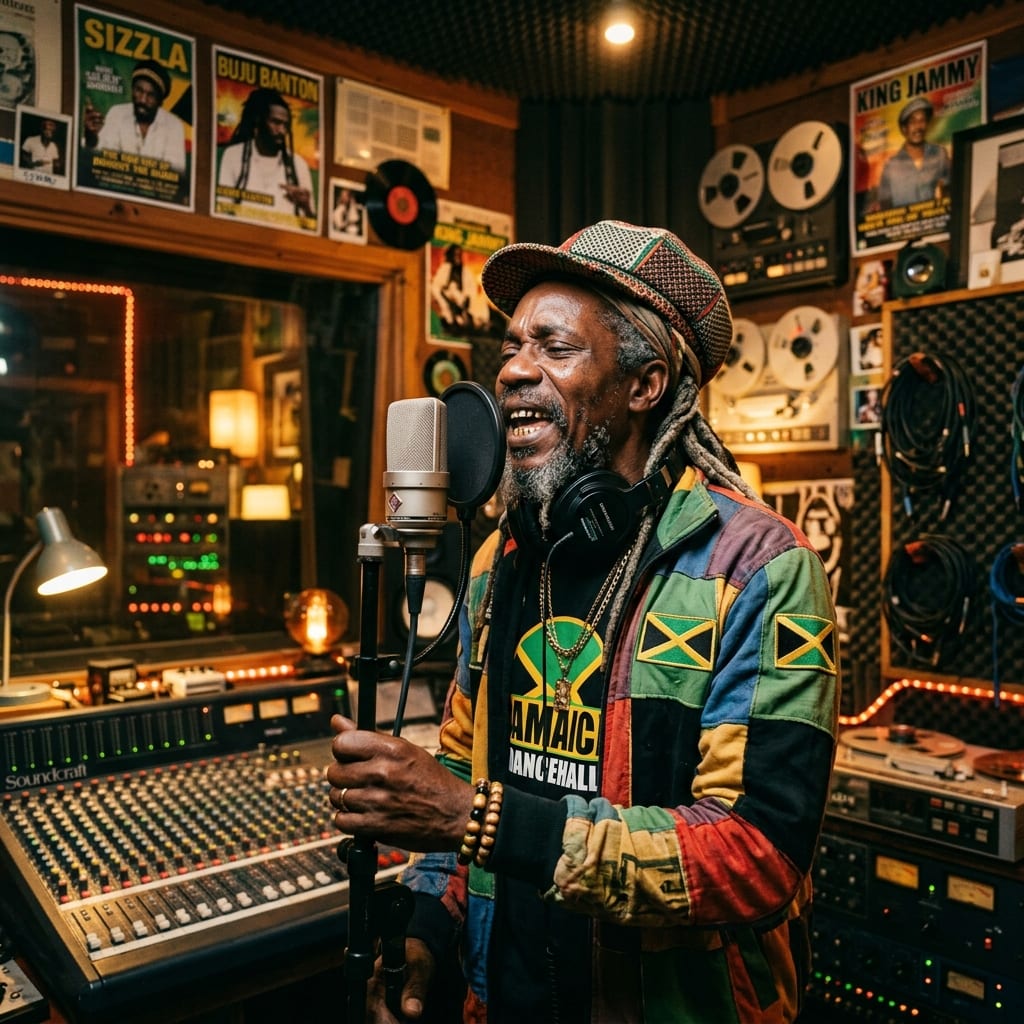
The wait is finally over for Dancehall fans worldwide. Today, global superstar Beenie Man released his highly anticipated 16-track album, Eminence.
There is a particular gravity that accompanies the arrival of new work from an artist who has already lived several lifetimes inside a single genre. Beenie Man is not a newcomer seeking introduction. He is a figure whose voice has already traveled the circuits of global sound for decades, shaping dancefloors, radio rotations, and the private playlists of people who may never set foot in Jamaica. When such an artist returns with a full project, the release is never only about the songs. It is about the continued assertion that the culture still has unfinished business, and that one of its most recognizable ambassadors still has something left to declare.
Eminence arrives as both a title and a claim. Eminence is not given. It is accumulated through years of presence, through the willingness to remain audible while tastes shift and generations turn over. In choosing that word, Beenie Man places the album inside a longer conversation about stature, continuity, and the right to still occupy the center of the frame. The sixteen tracks that follow are the evidence he offers in support of the claim.
A Star-Studded Project
The new project is packed with heavy-hitting collaborations that bridge the gap between Dancehall and international Hip-Hop. Featured artists include Snoop Dogg, Rick Ross, T.I., and Ashanti.
On the local front, Beenie Man tapped some of the brightest stars in Jamaican music to join him, including Vanessa Bling, Shaneil Muir, and the "Energy God" himself, Elephant Man.
Collaboration, at this level, is never neutral. It is a form of cultural diplomacy conducted in rhythm and verse. When Beenie Man links with Snoop Dogg, Rick Ross, T.I., and Ashanti, the links are not merely commercial calculations, though commercial calculations are certainly present. They are also statements about lineage and mutual recognition. Hip-Hop and Dancehall have been in conversation for generations, sometimes openly, sometimes through unacknowledged borrowing, sometimes through genuine respect. An album that places these voices in deliberate relation reopens that conversation at a moment when both genres continue to evolve under the pressures of global streaming and shifting audience demographics.
The local features perform a different but equally important function. Vanessa Bling, Shaneil Muir, and Elephant Man represent distinct frequencies within the contemporary Jamaican soundscape. Their presence on Eminence keeps the project tethered to the island even as it reaches outward. It prevents the album from floating free as pure crossover product. The “Energy God” sharing space with the elder statesman is itself a small philosophy of succession: the recognition that vitality in Dancehall has always depended on the willingness of established figures to stand beside, rather than merely above, the next wave.
"This album is about showing the world that Dancehall is limitless. We brought together the best of both worlds," a source close to the production noted.
The language of limitlessness is ambitious, and ambition is part of the point. Dancehall has repeatedly been declared finished, regional, or commercially exhausted, only to reappear in new forms, on new platforms, in the mouths of new artists who treat its rhythmic DNA as living material rather than archival curiosity. Beenie Man’s career is itself one of the longest-running refutations of those premature endings. By assembling a project that deliberately mixes traditional rhythmic foundations with contemporary crossover textures, he stages a practical argument: the genre’s boundaries are not fixed by external opinion. They are redrawn by the artists who continue to work inside them.
There is a deeper philosophical current running beneath the guest list and the production choices. What does it mean for an artist to claim eminence in a culture that prizes both innovation and respect for origins? Eminence suggests height, visibility, and a certain earned authority. Yet authority in Dancehall has never been purely hierarchical. It has always been tested in real time, on the sound system, in the dance, in the willingness of the crowd to answer back. An album titled Eminence must therefore do more than announce stature. It must demonstrate continued relevance. The collaborations, the rhythmic choices, the decision to release a full sixteen-track body of work rather than a scatter of singles—all of these are part of that demonstration.
The bridging of Dancehall and Hip-Hop is not a new gesture, but it remains a consequential one. The two forms have fed each other for decades: rhythmic ideas, vocal approaches, attitudes toward storytelling and swagger, even the business models that allow artists to move between local dominance and international visibility. When Beenie Man stands beside Snoop Dogg or Rick Ross, the standing is mutual. Each artist brings a different history of survival inside commercial music systems that have not always been hospitable to Black expressive cultures. The resulting tracks become temporary meeting grounds where those histories can acknowledge one another without requiring either to surrender its distinctiveness.
Ashanti’s presence adds another layer. Her career has moved through R&B, Hip-Hop adjacency, and periods of both intense visibility and relative quiet. To place her voice inside a Beenie Man project is to extend the conversation beyond the expected masculine circuits of Dancehall-Hip-Hop exchange. It suggests that the “both worlds” referenced by the production source are not only geographic or generic, but also textured by different approaches to melody, vulnerability, and star power.
On the Jamaican side, the inclusion of younger and contemporaneous voices performs an act of internal continuity. Dancehall has sometimes struggled with the tension between its veterans and its emerging talents. Projects that successfully place them in the same creative frame help to ease that tension. They model a version of the culture in which eminence does not require the displacement of the next generation, and in which the next generation does not need to erase the previous one in order to claim space. Elephant Man’s appearance is especially resonant in this regard. His own career has been defined by relentless energy and a refusal to recede. Standing beside Beenie Man, he embodies a parallel claim to longevity inside the same sound world.
The album’s early performance on global streaming platforms is already being read as evidence of commercial viability. Streaming metrics, for all their limitations, have become one of the primary languages through which contemporary music declares its continued life. For a Dancehall project to register strongly in those metrics is to assert that the audience for this music is not confined to nostalgic enclaves or regional markets. It is dispersed, digital, and still hungry for new material from artists who carry historical weight. Whether that hunger translates into sustained dominance of the airwaves through the rest of 2026 will depend on factors no single release can fully control: radio programming, playlist algorithms, touring support, and the unpredictable chemistry between songs and the cultural moment.
Yet the deeper success of Eminence will not be measured only in streams or chart positions. It will be measured in the way the project positions Dancehall inside the present tense. Does it feel like a backward glance, or like a forward claim? Does it treat the genre’s history as a resource to be mined, or as a living tradition still capable of invention? The presence of both international heavyweights and local contemporaries suggests an attempt at the latter. The album refuses to choose between respect for origins and appetite for expansion. It tries to hold both.
There is a quiet philosophy of aging in artistry at work here as well. Popular music systems often treat longevity as a problem to be managed rather than a resource to be valued. Artists who remain visible across decades are frequently asked to justify their continued presence, as if the mere passage of time were a form of obsolescence. Beenie Man’s decision to release a substantial, collaboration-rich album in 2026 is a refusal of that logic. It asserts that eminence, once earned, can be renewed through work rather than merely defended through reputation. The work itself becomes the argument.
For Dancehall as a whole, projects like this perform a public service that is easy to overlook. They keep the genre’s most recognizable voices in active circulation. They provide platforms on which younger artists can appear alongside established ones. They remind international audiences that the culture is not a static archive of riddims and slang, but a continuing practice. In an era when algorithmic discovery can flatten historical context, an album that deliberately stages encounters across generations and geographies helps to restore some of that context.
The title Eminence will ultimately be tested by the music itself. Titles make claims. Tracks must substantiate them. Listeners will decide whether the sixteen songs justify the height the name implies. Some will come for the guest features. Others will come for the familiar cadence of Beenie Man’s delivery, the particular authority he brings to a riddim, the sense that the voice still knows how to command a space. The most interesting responses will likely come from those who hear both: the history and the present tense, the local and the global, the claim to stature and the willingness to still collaborate as if the conversation remains open.
In the end, the release of Eminence is a reminder that cultural forms do not survive by freezing themselves in their most celebrated moments. They survive by continuing to move, to incorporate new voices, to risk new combinations, and to insist on their own unfinished nature. Beenie Man has spent a career embodying that insistence. With this album, he extends it once more—sixteen tracks long, threaded with the voices of friends and fellow travelers from Kingston to the wider world, and offered as evidence that Dancehall’s eminence is not a relic. It is a practice still in motion.