
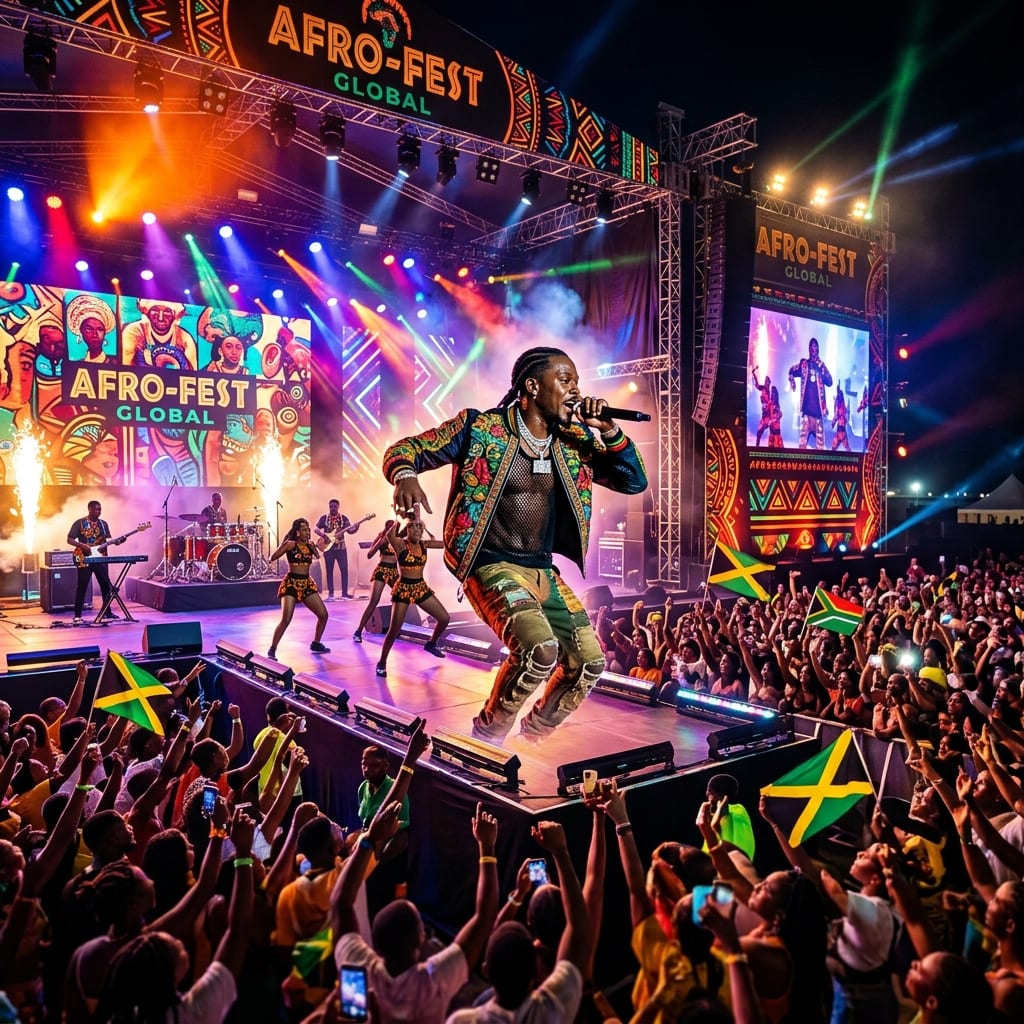
The relationship between Jamaican Dancehall and West African Afrobeats has become one of the most interesting developments in contemporary popular music. What was once largely seen as a series of individual collaborations between artists from different parts of the world has developed into a broader musical exchange, connecting Kingston, Lagos, Accra, London, New York and other major cultural centres.
At the heart of that exchange is a simple connection: rhythm. Dancehall and Afrobeats developed in different environments and have their own histories, sounds and identities, but both place a strong emphasis on rhythm, movement and vocal personality. As artists continue to experiment across those boundaries, the distinction between the two sounds has become increasingly fluid.
The result is sometimes described as Afro-Dancehall, although there is no single definition of the term. For some listeners, it refers to Dancehall records incorporating Afrobeats production and melodic elements. For others, it describes African music influenced by Jamaican rhythms and vocal styles. In practice, the label covers a wide range of music rather than one fixed formula.
The Roots Run Deeper Than the Current Wave
The growing relationship between Jamaica and West Africa is not a completely new phenomenon. Jamaican reggae, Dancehall and sound-system culture have influenced musicians around the world for decades, including artists across Africa.
Reggae's influence became particularly visible in African popular music during the second half of the 20th century. Jamaican artists established international audiences, while African musicians incorporated reggae's rhythms, messages and production techniques into their own work.
Dancehall later expanded that influence. The genre's emphasis on rhythm, deejay culture and distinctive vocal delivery gave artists another Jamaican musical language to draw from. As Jamaican music became increasingly accessible through radio, television, music videos and eventually the internet, its influence travelled even further.
At the same time, African popular music was developing rapidly. What is now commonly referred to as Afrobeats emerged from several musical traditions and developed into a major international sound. Artists began combining African rhythms with elements of pop, R&B, hip-hop, reggae and Dancehall.
That history helps explain why the current crossover does not feel completely unfamiliar to either audience. The artists may come from different countries, but the musical conversation has been taking place for generations.
Why Dancehall and Afrobeats Work Together
One reason the combination has proved effective is that the two styles can complement each other without requiring either one to disappear completely.
Dancehall often brings a strong rhythmic foundation and a direct vocal approach, while Afrobeats can introduce melodic hooks, layered percussion and a different approach to song structure. Producers can combine these elements in different proportions depending on the artist and the intended audience.
The result can range from a distinctly Jamaican Dancehall track with African influences to an Afrobeats record featuring a Jamaican deejay or singer. Some productions sit almost directly in the middle, making it difficult for listeners to place them within a single category.
That flexibility is particularly useful in today's streaming environment. Listeners are no longer necessarily discovering music through traditional genre categories. A person can move from a Jamaican Dancehall playlist to an Afrobeats playlist within minutes, and an artist can reach audiences in several countries without having to fit neatly into one musical market.
Collaboration Has Become a Major Part of the Story
Artist collaborations have played an important role in bringing the two musical worlds closer together. Jamaican and African artists have increasingly appeared on each other's records, while producers have experimented with rhythms and sounds associated with both regions.
For established artists, these collaborations can provide access to audiences that might otherwise be difficult to reach. For emerging musicians, working with artists from another market can introduce their music to new listeners and create opportunities for performances, partnerships and international distribution.
There is also a cultural dimension to these collaborations. A Jamaican artist working with an African artist is not simply combining two commercial markets. The music can create a conversation between communities with historical and cultural connections that extend far beyond the recording studio.
That element has become increasingly important as younger audiences explore questions of African identity, Caribbean culture and the wider African diaspora. Music provides one of the most accessible ways for those conversations to take place.
Streaming Changed the Equation
The rise of streaming has dramatically changed how music from Jamaica and Africa reaches international audiences. In the past, an artist hoping to break into another territory often depended on record labels, radio programmers, physical distribution and traditional media.
Today, a song can move between countries almost instantly. A track released in Kingston can be discovered by listeners in Lagos, while an artist from Nigeria can build an audience in Jamaica without first securing a traditional international distribution deal.
Playlists, short-form video platforms and social media have accelerated that process. Songs can gain attention because of a dance challenge, a memorable hook or a collaboration, with listeners often discovering the artists only after the song has already started circulating.
For Afro-Dancehall in particular, this environment creates an opportunity because the music is naturally suited to performance and movement. A strong rhythm can travel across language barriers, while a memorable chorus can give listeners an immediate entry point into a song.
Jamaica's Position in the Conversation
For Jamaica, the growing relationship with African music represents both an opportunity and a challenge.
Jamaican music has an enormous historical influence, but the global music industry has changed considerably. Artists now compete for attention in an environment where music from Africa, Latin America, the Caribbean, the United States and Europe can all appear on the same playlist.
The growing popularity of Afrobeats demonstrates the commercial potential of African music on the international stage. Jamaican artists and producers have an opportunity to participate in that expansion while maintaining the musical identity that made Dancehall influential in the first place.
That does not necessarily mean changing Dancehall to make it sound more international. In many cases, the strongest collaborations are those in which both artists retain recognizable elements of their own musical backgrounds.
There is a difference between collaboration and imitation. The long-term opportunity may be greatest when Jamaican musicians bring something distinctly Jamaican to the partnership while African artists bring their own musical traditions to the record.
The Business Behind the Music
The crossover is also creating opportunities beyond the songs themselves. Music publishers, producers, promoters, streaming platforms, record labels and independent management companies all have reasons to pay attention to the growing connection between Caribbean and African markets.
International collaborations can lead to concerts, festival appearances, brand partnerships and licensing opportunities. A successful song can also introduce an artist to markets where they previously had little recognition.
For independent artists, the digital economy makes this especially significant. An artist does not necessarily need to be signed to one of the world's largest record companies to release music internationally. Distribution platforms and social media have lowered some of the barriers that previously limited access to global audiences.
However, international exposure does not automatically translate into long-term success. Artists still need strong management, reliable distribution, marketing, publishing administration and a clear strategy for building audiences beyond a single viral record.
The Cultural Impact
Perhaps the most significant part of the Afro-Dancehall movement is not its commercial potential but what it represents culturally.
Jamaica and West Africa have long been connected through history, migration and culture. Music has repeatedly provided a way for those connections to be expressed and renewed.
Modern collaborations allow younger generations to participate in that exchange in a way that previous generations could not. A listener in Kingston can become familiar with an artist from Lagos through a single song, while someone in Accra can discover Jamaican Dancehall through the same collaboration.
That exchange can also challenge the idea that Caribbean and African music exist as completely separate categories. The more artists collaborate, the more listeners are exposed to the similarities and differences between the musical traditions.
What Comes Next?
The next stage of the Afro-Dancehall movement may be less about creating a new genre and more about removing the boundaries between existing ones.
Artists are increasingly comfortable drawing from multiple musical traditions. Producers can combine rhythms from different regions, while listeners are less concerned about whether a particular song belongs to one traditional category or another.
That does not mean Dancehall or Afrobeats will disappear into one unified sound. Both genres have distinct histories and communities, and those identities remain important. Instead, the future is likely to involve more experimentation at the intersection of those traditions.
The artists who benefit most may be those who understand that collaboration requires more than placing two popular names on the same record. The strongest partnerships are likely to come from genuine musical exchange, where each artist contributes something recognizable while also allowing the other tradition to influence the final production.
For Jamaica, the opportunity is significant. Dancehall remains one of the country's most recognizable cultural exports, while Afrobeats has demonstrated the enormous international appetite for contemporary African music. Bringing those worlds together creates another pathway for Caribbean and African artists to reach global audiences.
Whether Afro-Dancehall ultimately becomes recognized as a formal genre or remains a loose description for a constantly evolving sound is difficult to predict. What is clear is that the musical relationship between Jamaica and West Africa is continuing to grow.
From Kingston to Lagos, the conversation is already happening in studios, on stages and across streaming platforms. The next chapter will likely be written by artists who are willing to look beyond traditional genre boundaries while still respecting the musical traditions that brought them there.
For listeners, that means more experimentation, more collaborations and potentially an even wider global audience for music rooted in the Caribbean and Africa. The sound may continue to change, but the connection behind it is much older than the latest hit record.