
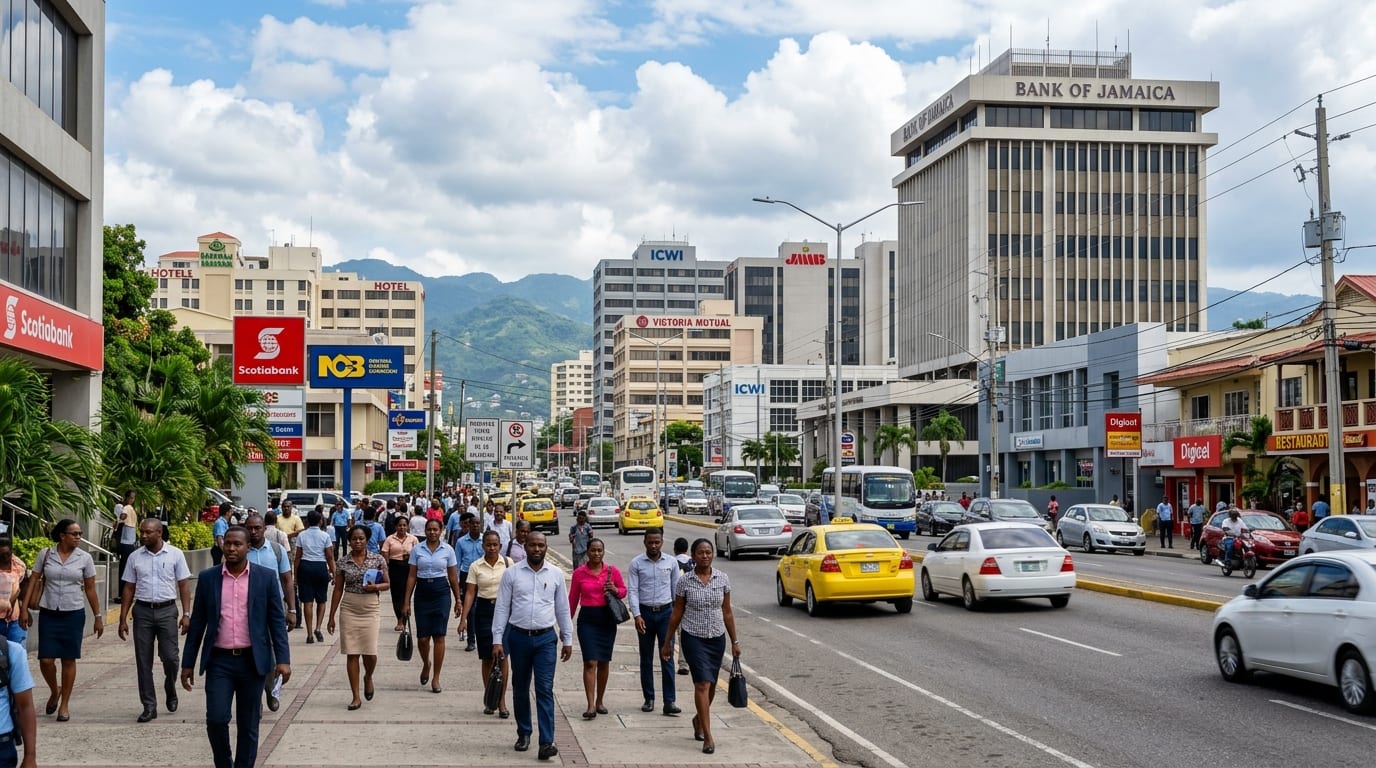
Jamaica's Planning Institute of Jamaica (PIOJ) confirmed this month that the country's economy contracted by 2.9 percent in the April-to-June 2026 quarter — the third consecutive quarterly decline, meeting the technical definition of a recession. The data, which reflects the lingering economic impact of Hurricane Melissa and persistent global headwinds, has prompted both concern and a measured policy response from Jamaica's financial authorities.
The Numbers Behind the Recession
A technical recession is defined as two or more consecutive quarters of negative economic growth, measured by Gross Domestic Product (GDP). Jamaica's latest data — which puts Q2 2026 at negative 2.9 percent — follows similar contractions in Q4 2025 and Q1 2026. The cumulative effect of these three quarters represents the most significant economic downturn Jamaica has experienced since the COVID-19 pandemic period of 2020.
The PIOJ has attributed the contraction primarily to three interconnected factors:
- Hurricane Melissa recovery costs: The hurricane, which struck the island in October 2025, caused significant damage to agricultural output, tourism infrastructure, and transportation networks. The economic ripple effects have been felt through every subsequent quarter.
- Global inflationary pressures: Jamaica, as a small open economy, is highly exposed to global commodity prices. Energy costs have remained elevated throughout 2026, increasing the cost of production across all sectors.
- Reduced tourist arrivals: Hurricane-related damage to resort facilities and negative international media coverage of the storm contributed to a slowdown in stop-over tourist arrivals in the first half of the year, squeezing a sector that normally drives a significant portion of GDP.
The Bank of Jamaica's Response
The Bank of Jamaica (BOJ) has maintained its benchmark interest rate at 5.50 percent, resisting calls to cut rates aggressively to stimulate growth. BOJ Governor Richard Byles has been clear about the reasoning: Jamaica's inflation rate, which reached 7.5 percent in July 2026, remains well above the central bank's target band, and premature rate cuts could further erode purchasing power for ordinary Jamaicans — particularly those in lower-income households most vulnerable to food and energy price increases.
The BOJ's approach reflects a difficult balancing act that central banks across the Caribbean are navigating: maintaining monetary credibility and currency stability while trying not to choke off recovery. Jamaica's exchange rate has remained relatively stable against the US dollar, a fact the BOJ cites as evidence that the policy mix is working even in difficult conditions.
Sector-by-Sector Breakdown
Not all sectors of Jamaica's economy have been equally affected. The PIOJ data shows divergent trends that complicate the simple recession narrative:
Agriculture: Hardest Hit
Agricultural output has seen the sharpest declines, with Hurricane Melissa destroying significant portions of the banana, pimento, and scotch bonnet crop in key growing parishes. Farmers in St. Elizabeth, Manchester, and Clarendon reported losses that will take multiple planting cycles to recover from. The government's rural development programme — backed by a US$50 million investment — is intended to accelerate recovery in these communities, but experts say meaningful impact will not be visible until 2027.
Tourism: Recovering, But Slowly
The good news from the tourism sector is that arrival numbers are recovering faster than initially projected. By June 2026, stop-over arrivals were tracking at approximately 85 percent of pre-hurricane levels — ahead of the Ministry of Tourism's own projections. The Jamaica Tourist Board has been running an aggressive international marketing campaign emphasising the island's resilience and the speed of its reconstruction efforts, and the response from major source markets in the United States, UK, and Canada has been positive.
Financial Services: A Bright Spot
The financial services sector has shown remarkable resilience. The Jamaica Stock Exchange (JSE) has maintained stability, and commercial banks have reported solid earnings driven by interest income from the higher-rate environment. Companies like Sagicor Group and NCB Financial Group have continued to grow their loan portfolios, suggesting that business investment in Jamaica has not stopped — it has simply become more selective and cautious.
Should Jamaicans Be Worried?
The honest answer is: concerned, but not panicked. Jamaica has navigated serious economic shocks before — the 2008 global financial crisis, the 2010 IMF agreement, the 2020 pandemic — and has emerged from each with its fiscal fundamentals strengthened. The country's debt-to-GDP ratio has fallen dramatically over the past decade, from over 130 percent in 2013 to under 80 percent today, giving the government more fiscal flexibility than it had in previous downturns.
PIOJ's own projections suggest that economic output could return to pre-Hurricane Melissa levels by early 2027 — a recovery timeline that, while painful, is faster than what Jamaica experienced after previous major storms. The government's infrastructure investment programme, particularly the rural water and road networks funded by the US$50 million allocation, is also expected to provide an economic stimulus effect in the second half of 2026.
The Ordinary Jamaican's Perspective
Behind the aggregate data are real families making difficult choices. Inflation at 7.5 percent means that the weekly grocery budget stretches less than it did a year ago. Transport costs — always a significant burden for lower-income Jamaicans who depend on route taxis and buses — have risen with fuel prices. And for the many Jamaicans employed in sectors connected to tourism or agriculture, the past three quarters have been genuinely hard.
What policymakers, economists, and ordinary Jamaicans agree on is that the path out of recession requires sustained investment in the productive sectors of the economy — not just in the headline metrics, but in the communities, farmers, small business owners, and workers who generate the real economic activity that GDP numbers are supposed to capture.
Jamaica has been here before. And Jamaica has come back before. The question now is how quickly — and how equitably — the recovery arrives.