
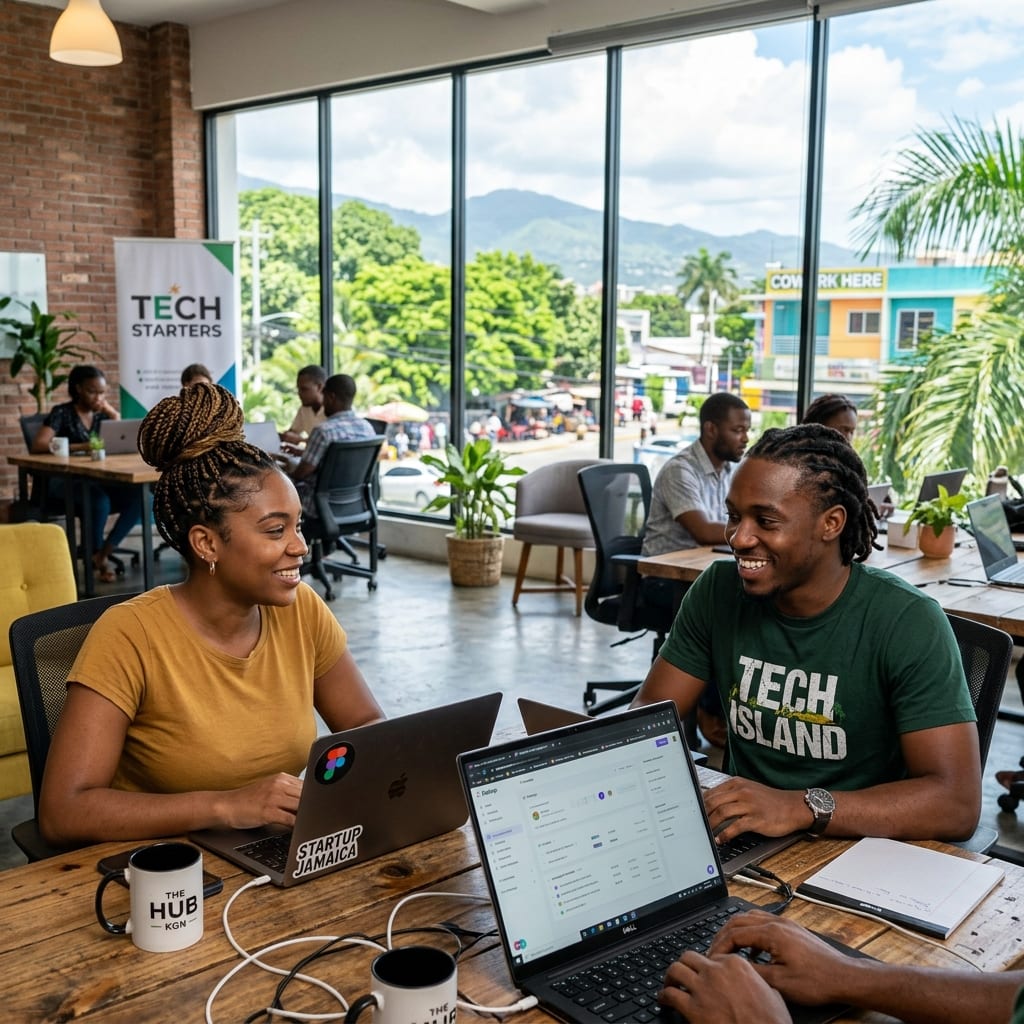
Often celebrated for its cultural exports, Kingston is rapidly gaining a new reputation: the tech capital of the Caribbean. A surge of digital entrepreneurship, fueled by young innovators and supportive policies, is transforming the city's economic landscape. I’ll be honest with you—when I first heard someone call Kingston the "Silicon Valley of the Caribbean," I laughed out loud. I was sitting in a rum bar in Half Way Tree, sweating through my shirt because the fan was broken again, and my phone had just dropped to one bar of service. Silicon Valley? Please. We can't even keep the lights on for a full business day. But then I started looking closer. And I have to admit—something is happening here. Whether it's the revolution everyone keeps claiming it is, or just another wave of island optimism that'll fizzle out when the grant money dries up, that's what I came here to find out.
The Co-Working Boom
Walk into any of Kingston's new co-working spaces, and the first thing that hits you is the aesthetic. Exposed brick walls painted in that specific shade of millennial teal. Succulents on every table. A Bluetooth speaker pumping out Lo-Fi Beats to Study To, because apparently even our background noise has to be imported.
I spent a Tuesday at CoWork Ja on Constant Spring Road, and yeah, there were developers hunched over laptops. There were whiteboards covered in agile workflows and wireframes. A guy named Damian, wearing a hoodie in 85-degree weather, told me he was building a fintech app to help unbanked Jamaicans access microloans. "We've got 400 beta users," he said, eyes lit up like he'd just discovered fire. "And we just got into a local incubator."
But here's the thing they don't put in the press releases. The Wi-Fi cut out twice in three hours. When it happened the second time, nobody even looked up from their phones—they just switched to their personal hotspots, burning through expensive data plans because Digicel and Flow still haven't figured out how to provide stable commercial internet north of Liguanea.
"We have the talent, we have the drive, and now we have the ecosystem to support it. Kingston is proving that world-class tech doesn't only come out of California." — Local Tech Founder
I wanted to believe him. I really did. But I also couldn't help noticing that the "ecosystem" he was talking about consisted of a rented office space, one overworked mentor who splits his time between four startups, and a coffee machine that was definitely bought on a payment plan.
Government and Private Investment
This renaissance isn't happening in a vacuum. That's what they keep telling us, anyway. Both the Jamaican government and private angel investors have supposedly recognized the potential of the tech sector. Incubator programs, tax incentives for digital startups, and improved internet infrastructure have laid the groundwork for this rapid growth.
Laid the groundwork. That's the phrase they use in the press releases.
I went to the Development Bank of Jamaica's website and looked up the specifics of these "tax incentives." Turns out, if you can navigate seventeen forms, prove you've hired at least five full-time employees, and wait approximately eight months for processing, you might get a break on your corporate taxes for two years. Two years. In startup time, that's basically a geological epoch. Most of these companies won't exist in two years.
And the internet infrastructure? Don't get me started. Sure, downtown Kingston got fiber upgrades. But I live in St. Andrew, and last week I lost connection for six hours because someone backed a truck into a pole on Hope Road. That's not a tech ecosystem. That's just life in a developing country with above-average ambition.
But okay. Fine. Let me give credit where it's due. There is money flowing. I met with Marlene, a former tourism executive who now calls herself an angel investor. She's put her own savings into three local startups over the past eighteen months. "I'm not doing this to get rich," she told me over jerk chicken at a spot near Devon House. "I'm doing it because I watched my son graduate from UWI with a computer science degree and then spend two years driving Uber because there were no jobs. These kids are brilliant. They just need someone to take a chance."
That got me. It really did. Because behind all the co-working space Instagram posts and the LinkedIn articles about "Caribbean innovation," there are actual young people who are tired of waiting for permission. They're building apps in their bedrooms, coding through power outages, teaching themselves machine learning from YouTube tutorials because the university curriculum is still stuck in 2008.
The Leapfrog Fantasy
As these startups scale and begin to attract international venture capital, Kingston is poised to become a blueprint for how emerging economies can leverage technology to leapfrog traditional development barriers. That's the narrative, anyway. I've read that exact sentence, or some variation of it, in at least four different think-pieces this year.
Leapfrog. It's such a tidy word. It suggests we can just skip over all the messy, expensive, time-consuming parts of development and land directly in the future. No need to fix our roads—we'll just build drone delivery networks. No need to reform our banking system—we'll just go straight to blockchain. No need to address our failing public education system—we'll just create ed-tech platforms that make up the difference.
I sat down with Dr. Herbert, an economist at UWI who specializes in digital development, and he gave me the kind of reality check that makes venture capitalists uncomfortable. "Technology doesn't exist in a vacuum," he said, leaning back in a chair that had definitely seen better decades. "You can't leapfrog institutional capacity. You can't leapfrog regulatory frameworks. You can't leapfrog the fact that our court system takes five years to resolve a contract dispute. These startups aren't operating in some frictionless digital utopia. They're operating in Jamaica. With all that that entails."
He wasn't being pessimistic. He was being Jamaican. We've seen too many "next big things" come and go. The garment factories in the seventies. The call centers in the nineties. The BPO boom of the 2000s. Each time, we were told this was the industry that would transform us. Each time, we built something modest and real, but never quite the transformation we were promised.
The Real Story
So what's actually happening in Kingston? Let me tell you what I saw.
I saw a 24-year-old woman named Tashana who built an agri-tech platform that helps small farmers in St. Elizabeth predict rainfall patterns using satellite data and local weather stations. She's not trying to be the next Silicon Valley unicorn. She's trying to help her grandfather's farm survive the next drought. Her platform is clunky, her server costs keep her up at night, and she still works a part-time job at a call center to pay rent. But she's helping forty farmers increase their yields by an average of fifteen percent. That's not a press release. That's a life.
I saw a group of former high school friends who built a delivery app specifically for Kingston's labyrinthine addressing system. They know that "third gate past the mango tree, ask for Miss Brown" isn't going to work with GPS, so they built a hybrid system that combines mapping technology with local knowledge. They have twelve drivers. They lose money every month. But they're still going.
I saw the skepticism in their eyes when I asked if Kingston was really becoming a tech hub. "Maybe," Tashana said. "But even if it's not, we're building something we need. And that's enough."
The Future Is What We Make It
The future of the Jamaican economy is increasingly digital. That much is true. You can feel it in the co-working spaces, in the university computer labs, in the late-night WhatsApp groups where founders share server error screenshots and encouragement in equal measure.
But is Kingston the next Silicon Valley? God, I hope not. Silicon Valley is a cautionary tale at this point—a place where brilliant people go to build apps that solve problems for rich people, while the city around them crumbles. We don't need that. What we need is what I actually found here: stubborn, scrappy, imperfect innovation born out of necessity rather than greed.
The government will take credit. The incubators will publish glossy reports. The international press will parachute in for a weekend and write breathless articles about "the Caribbean's tech revolution." And maybe, in a few years, some of these startups will make it. Most won't. That's just math.
But something has shifted. I felt it. Not in the teal-painted co-working spaces or the carefully curated networking events, but in the quiet determination of kids who grew up being told their only options were tourism or migration, and who are now building a third option with their own hands.
Is it a boom? Maybe. Is it sustainable? Your guess is as good as mine. But is it real?
Yeah. It's real. Just don't call it Silicon Valley. Call it Kingston. And understand that those two things were never supposed to be the same.