
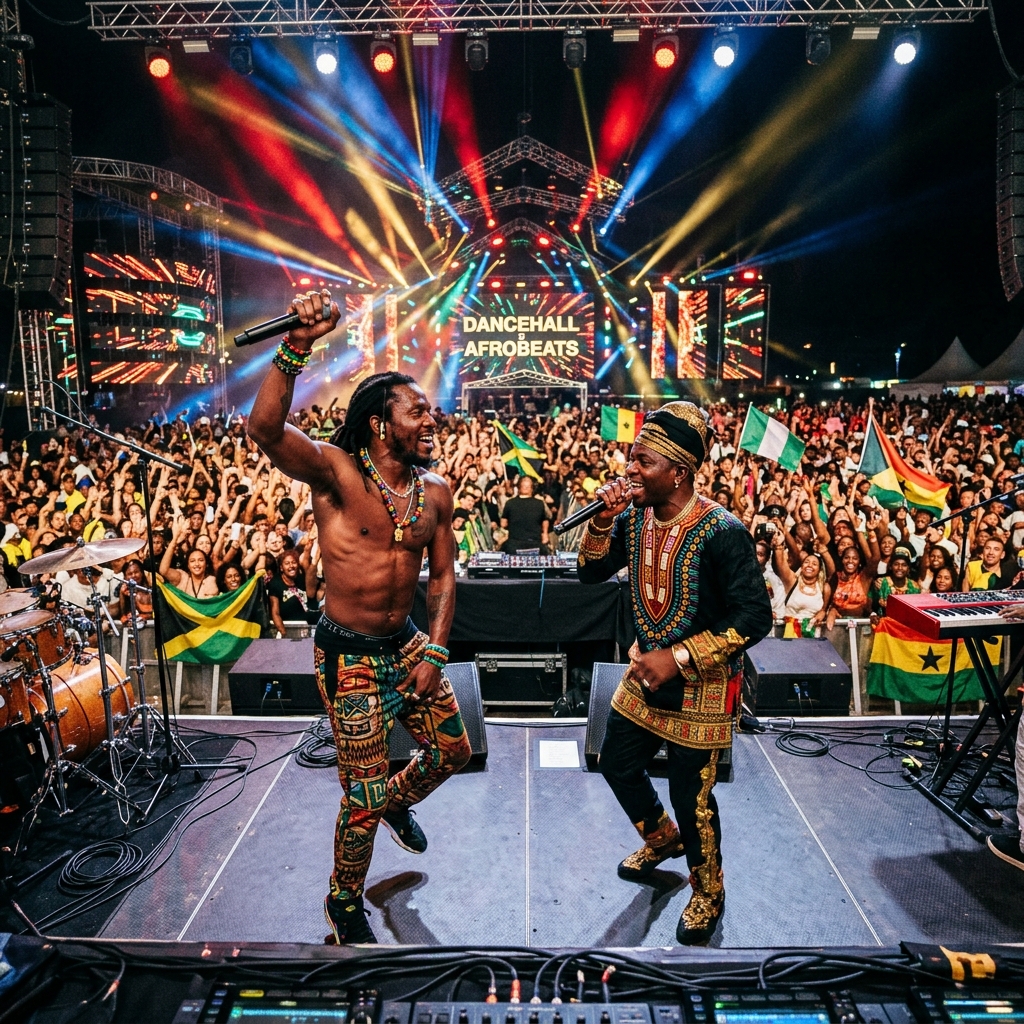
A powerful, rhythmic revolution is currently dominating the global music industry, tearing down geographical borders and bridging a centuries-old cultural gap across the Atlantic Ocean. The genre, widely known as Afro-Dancehall, is a seamless, intoxicating fusion of traditional Jamaican dancehall percussion and the infectious, melodic bounce of West African Afrobeats. This musical synthesis is not just creating summer anthems; it is fundamentally shifting the global pop landscape.
The Anatomy of a Global Sound
For decades, Jamaican dancehall and African music scenes existed in parallel, maintaining a deep mutual respect but rarely officially crossing paths on a large commercial scale. However, the digital streaming era and the massive, explosive global rise of Afrobeats over the last five years have changed the game entirely. Today, the collaboration between Kingston and Lagos—or Accra—is not just common; it is highly expected and highly profitable.
The Afro-Dancehall sound is characterized by a slightly slower BPM than traditional 90s dancehall, replacing the aggressive, hardcore digital stabs with lush, atmospheric synthesizers, heavy 808 sub-bass, and traditional African polyrhythms. The vocal delivery often features Jamaican artists softening their patois to blend seamlessly with the melodic, auto-tuned hooks delivered by Nigerian or Ghanaian superstars in Pidgin English or Yoruba.
"It's a very natural progression," explained a prominent Kingston-based producer who recently scored a Billboard Top 10 hit with an Afro-Dancehall track. "When you strip away the modern production, the core drum patterns of dancehall have always been inherently African. We are just bringing the music back to its ancestral roots and packaging it for a global club audience."
Massive Collaborations Leading the Charge
The commercial viability of this crossover was solidified by massive global hits, but the current wave is seeing unprecedented collaboration at the album level. Jamaican superstars like Popcaan, Shenseea, and Skillibeng are frequently jetting off to Nigeria to record directly with Afrobeats giants like Burna Boy, Wizkid, and Davido. Conversely, African artists are increasingly flying into Kingston to shoot music videos in the streets of Jamaica, paying deep homage to the island's sound system culture.
These collaborations are highly lucrative, allowing artists to cross-pollinate their massive fanbases. A track featuring a top Jamaican act and a top Nigerian act practically guarantees immediate chart dominance across the Caribbean, the entire African continent, and the massive diaspora populations in the UK and North America.
Cultural Reconnection Beyond the Music
Beyond the billions of Spotify streams and sold-out arena tours, the rise of Afro-Dancehall represents a deeply significant cultural reconnection. Many of the collaborative tracks explicitly explore themes of shared ancestry, the painful history of the transatlantic slave trade, and the shared modern struggles of post-colonial life in both Jamaica and West Africa.
The music videos often feature a deliberate blending of cultures—Jamaican Dancehall Queens performing alongside traditional African dancers, seamlessly mixing the "Bogle" with the "Shaku Shaku." This visual and sonic unity has fostered a massive sense of pan-African pride among younger generations globally.
As major international record labels scramble to sign artists who can navigate both genres, Afro-Dancehall shows absolutely no signs of slowing down. It stands as a vibrant, undeniable testament to the enduring power of Black musical innovation, proving that the rhythmic connection across the Atlantic remains as strong and unbreakable as ever.