
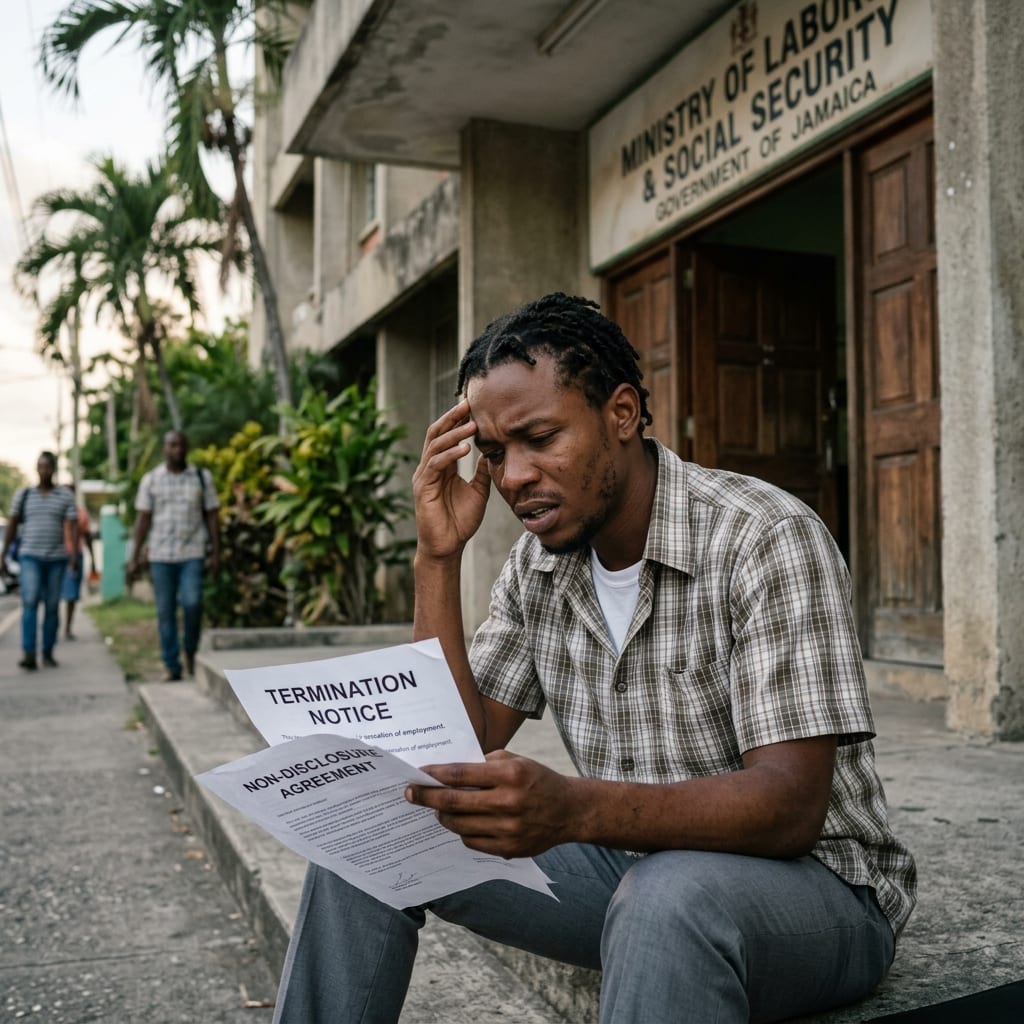
Fired and Forgotten: The Ministry of Labour's Rubber Stamp
The relationship between an employer and an employee is naturally unequal since employers have control over people's pay and thus determine the financial situation of the workers who help to build up their businesses. In order to achieve a balance to this imbalance and to make sure that workers are treated fairly, governments create labour ministries. Theoretically, the Jamaican Ministry of Labour and Social Security is set up to protect the rights of workers, to look into cases of abuse and to make predatory companies answerable. In reality, though, it often functions no more than a mere rubber stamp for corporate wrongdoing.
When Jamaican workers are unfairly dismissed, exploited, or have legal contracts used against them, they usually go to the Ministry for redress. Unfortunately, they are generally met with a bureaucratic attitude that shows no concern and is unwilling to look beyond the surface, thereby enabling companies to conceal their improper actions without any consequences.
The Pre-Probation Trap
A clear example of corporate exploitation in Jamaica is the deliberate and dishonest dismissal of employees just as their probation period comes to an end.
Imagine a situation which happens far too frequently: a competent professional, for example a software developer, is employed and puts in hard work for several months. They achieve their objectives, become integrated into the team, and look forward to their upcoming confirmation, since this brings job security, benefits, and usually a rise in salary. Suddenly, however, they are dismissed two days before the probation period is supposed to end.
The reasons offered are frequently vague, contradictory or completely made up. There are instances in which a company says that a third-party client «no longer wants to work with them», only for the employee afterwards to find out that the client knows absolutely nothing about the situation.
Any objective observer would see it as a major warning sign if an employee was fired two days before they were due to be promoted or confirmed, especially in the absence of a record of poor performance or any disciplinary problems. This situation clearly indicates that the company has never intended to retain the employee and is simply taking advantage of their work during the probationary period in order to avoid having to pay benefits or commit to permanent employment.
The Ministry's Refusal to Investigate
If a worker realizes that they have been unfairly and deliberately dismissed, they will go to the Ministry of Labour and expect an inquiry to be carried out. They expect the Ministry to obtain the employee's file, examine the grounds for the dismissal, and notice the clear lack of good faith in firing the person just 48 hours before their probation period comes to an end.
Rather, the Ministry's reply is dominated by a lack of concern. They seldom examine the actual contract, the email exchanges, or the circumstances surrounding the dismissal. The Ministry's involvement is generally limited to a simple, mathematical calculation. The only question, and usually the main one, that they ask is "Did the company pay you for the notice period?"
If the company pays the employee a sum equal to one month's salary instead of giving notice, then the Ministry regards the issue as settled. They argue that since the employee has received the standard financial severance, the company's actions are considered justified. They do not investigate the 'cause' of the dismissal and make no effort to find out whether the resignation was discriminatory, retaliatory, or amounted to a deliberate misuse of the probation laws.
The Ministry says to the worker, "You've been paid for the month, so that ends it." Since it bases the workers' rights merely on a simple severance payment, the Ministry entirely fails to take into account the psychological, professional, and long-term financial harm caused by the improper dismissal. As before, no one is willing to carry out the real work of investigating and holding the powerful to account.
Silenced by NDAs: The Corporate Cover-Up
This problem is made worse by the widespread misuse of Non-Disclosure Agreements (NDAs). When Jamaican companies carry out toxic, unethical, or illegal employment practices—such as the practice of firing employees before they are officially hired—they are afraid of coming to public attention. In order to protect their reputations they are now more and more likely to use NDAs as a tool.
Employees who have been terminated are frequently made to sign non-disclosure agreements, either by pressure or financial incentive, which stop them from talking about their time at the company. These legal agreements ensure that the public never finds out about the high rate of staff turnover, the abusive management, or the systematic exploitation of workers.
The Ministry of Labour ought to be very worried about firms which place great reliance on NDAs in order to keep former employees quiet. Such a practice shows clearly that there is a hostile working environment and may amount to a breach of labour law. Nevertheless, the Ministry ignores this behaviour as well, permitting companies to secure the silence of the workers whom the government is responsible for protecting.
A Call for a Proactive Ministry
The Jamaican workforce ought to have a Ministry of Labour which functions as a shield rather than as a spectator; one that merely verifies whether a final paycheque has been paid is of no use when it comes to dealing with the way modern corporations exploit their workers.
We need an investigative body which searches for patterns of abuse. If a company keeps firing people a day or so before their probation period finishes, the Ministry should carry out a full audit of its employment practices. The Ministry also has to oppose the general use of NDAs intended for the purpose of hiding toxic workplace cultures and violations of labour laws.
So long as the Ministry of Labour decides not to take a more active role and actually promote the interests of the Jamaican worker, companies will keep on operating under the belief that they can dismiss employees without any reason, take advantage of them without facing any repercussions, and put an end to their victims' voices with a simple stroke of the pen. The working class is engaged in a struggle on two fronts: one against predatory employers and the other against the government organisations which are meant to support them.
Our Philosophy
An employment contract should be a mutual agreement of value, not an instrument of exploitation. When regulatory bodies fail to be the sword and shield of the worker, the worker must find strength in their own truth. We believe that forced silence through NDAs is a sign of moral bankruptcy, used by those who fear the light of accountability. True corporate responsibility is not found in a calculated severance check; it is found in transparency, respect, and the unyielding demand for dignity in the workplace. We will no longer trade our voices for their comfort.