
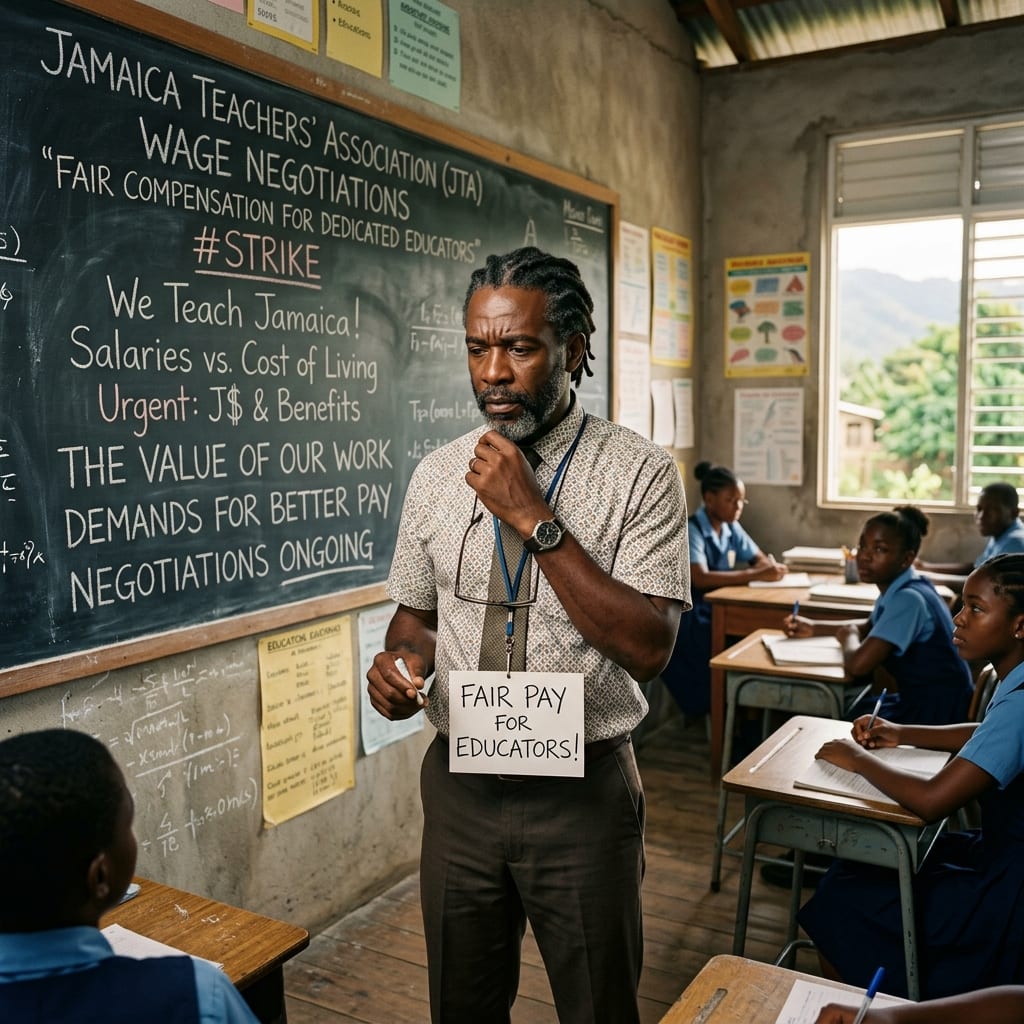
The Jamaica Teachers' Association (JTA) has formally rejected the latest wage and compensation offer proposed by the Government, setting the stage for what could be a contentious period of negotiations as the new school year approaches. The decision, handed down during the JTA's 62nd annual conference, underscores deep-seated frustrations among the nation's educators regarding their current compensation structure and outstanding allowances.
There is a particular weight that settles over a profession when its practitioners feel the gap between their contribution and their recognition has grown too wide to ignore. Teaching has never been only a job. It is one of the few occupations in which the daily work is an act of faith in a future the worker may never fully see. When those who shape the minds of a nation declare that the terms on which they are asked to continue are no longer acceptable, the disagreement is never merely about numbers. It is about dignity, about the social contract, and about whether a society is prepared to value the people who prepare its children for the world.
The rejection at the 62nd annual conference is therefore more than a bargaining position. It is a collective statement that the present arrangement no longer holds. Educators who have spent years in classrooms, often under conditions that demand personal sacrifice, have decided that silence is no longer sustainable. In doing so, they force a public conversation about what a nation owes those who form its intellectual and moral foundations.
Unresolved Concerns at the Core of the Dispute
According to delegates at the conference, the rejection stems from several critical areas where the government's proposal fell short. Chief among these are the long-standing issues surrounding uniform allowances and the absence of a comprehensive graduate policy. Educators who have pursued further studies feel that their additional qualifications and the resulting expertise they bring to the classroom are not adequately recognized or compensated under the current framework.
"We are professionals who have dedicated our lives to molding the future of this nation," stated one passionate delegate from St. Catherine. "When we invest in ourselves through higher education, we expect that investment to be acknowledged. The current offer simply does not reflect the reality of the economic pressures we face daily, nor does it value the critical role we play in Jamaica's development."
There is a quiet philosophy at work in the demand for a graduate policy. When a teacher invests time, money, and energy to deepen knowledge, that investment is not private. It returns to the classroom in the form of sharper questions, richer explanations, and a higher standard of intellectual care for students. To leave such effort unacknowledged is to treat professional growth as a personal luxury rather than a public good. The absence of a coherent policy on this matter suggests a deeper undervaluation: the idea that the teacher’s mind is secondary to the teacher’s presence. Yet presence without continuous intellectual renewal eventually becomes routine, and routine is the enemy of genuine education.
Uniform allowances, often dismissed as a minor line item, carry their own symbolic weight. They speak to the daily reality of appearing in front of young people as a figure of authority and care. When the cost of maintaining that professional appearance falls disproportionately on the teacher, the message is clear: the outward signs of the profession are the individual’s burden. Small as the allowance may seem in a national budget, its neglect signals a larger indifference to the lived texture of the work.
The delegate’s words cut to the heart of the matter. Teaching is an act of national formation. Those who perform it are not merely delivering a curriculum; they are shaping the citizens who will one day decide the country’s direction. When those citizens-in-formation see their teachers treated as afterthoughts in the fiscal conversation, they absorb a lesson more powerful than any textbook: that some forms of labor, however essential, remain negotiable. That is a dangerous lesson for any society that hopes to value knowledge.
Economic Realities and Cost of Living
The wage dispute is taking place against a backdrop of broader economic challenges. While the Planning Institute of Jamaica (PIOJ) recently confirmed that the country is not in a recession—despite a 2.9% economic contraction in the April–June quarter following the devastating impacts of Hurricane Melissa—the cost of living remains a pressing issue for many public sector workers.
Teachers argue that inflation and the rising costs of basic goods and services have severely eroded their purchasing power. The JTA leadership has emphasized that any acceptable compensation package must go beyond mere nominal increases and address the structural issues that have historically left teachers feeling undervalued.
There is a philosophical tension here that no budget document can fully resolve. A government must manage finite resources, especially after a disaster of Melissa’s magnitude. Fiscal responsibility is not optional. Yet the same government depends on a teaching force that arrives each morning prepared to give more than the minimum. The erosion of purchasing power is not an abstract economic indicator for the teacher who must choose between textbooks for the classroom and food for the household. It is a daily negotiation with scarcity that slowly depletes the emotional reserves required for excellent teaching.
Philosophers of labor have long observed that work which is both essential and poorly compensated creates a particular form of quiet suffering. The worker continues because the work matters, yet the continuation itself becomes a source of resentment. Over time, the resentment risks hardening into detachment. A detached teacher may still cover the syllabus, but the deeper transmission of curiosity, resilience, and moral seriousness becomes harder to sustain. In this sense, inadequate compensation is not only unfair to the individual teacher; it is a slow tax on the quality of the education system itself.
The post-hurricane context sharpens the dilemma. Recovery requires national cohesion. Teachers are among the first adults many children encounter after trauma. Their stability, their capacity to create order and hope inside a classroom, becomes part of the island’s healing. To ask them to perform that role while their own economic foundation remains unstable is to place a heavy moral burden on an already demanding profession.
Impact on the Upcoming Academic Year
With the new academic year just around the corner, the impasse raises concerns about potential disruptions. The Ministry of Education, which recently celebrated improvements in 18 of 34 CSEC subjects, relies heavily on a motivated and stable teaching workforce to maintain and build upon these academic gains. A prolonged dispute could impact morale and, by extension, the quality of instruction in the classroom.
The JTA has urged the government to return to the negotiating table with a revised, more substantial offer that addresses the specific grievances outlined by the delegates. "We are ready to talk, but we are not ready to settle for less than what is fair," the JTA spokesperson noted. "Our members have spoken clearly, and we stand resolute in our demand for equitable compensation."
Morale is an invisible infrastructure. Test scores and CSEC improvements are measurable, and the Ministry is right to celebrate them. Yet those gains rest on the daily willingness of teachers to prepare, to adapt, to notice the struggling student, to stay late, to care. When that willingness is strained by unresolved grievances, the gains become fragile. A classroom can continue to function under low morale, but it rarely thrives. The difference between functioning and thriving is precisely the difference between a society that merely processes its young people and one that genuinely educates them.
There is also a temporal philosophy at stake. Education is an investment whose returns are delayed. The benefits of a well-supported teacher appear years later in the form of competent professionals, thoughtful citizens, and a more capable workforce. Governments, operating on shorter political cycles, sometimes struggle to weigh distant returns against immediate fiscal pressures. Teachers, living inside the daily reality of the classroom, experience the cost of underinvestment in real time. The present dispute is, in part, a collision between these two time horizons.
The JTA’s insistence on returning to the table with a more substantial offer is therefore not obstruction. It is a refusal to accept that the only possible conversation is one of constraint. Fairness, in this context, is not a luxury. It is the condition under which the profession can continue to attract and retain people of ability and commitment. Without that condition, the long-term quality of Jamaican education becomes a matter of hope rather than design.
Looking Ahead
The coming weeks will be critical as both sides attempt to find common ground. The government faces the delicate task of balancing fiscal constraints—exacerbated by the estimated US$12.2 billion in damage caused by Hurricane Melissa—with the legitimate demands of one of its most vital public sector groups. As the nation watches, the hope remains that a swift and amicable resolution can be reached, ensuring that Jamaica's students are the ones who ultimately benefit from a focused and valued teaching profession.
Every negotiation of this kind is also a negotiation about the kind of society Jamaica intends to be. Does it treat its teachers as costs to be managed, or as partners in the project of national development? Does it regard the classroom as a site of temporary holding, or as the primary workshop in which the next generation is formed? The answers to these questions are never fully stated in policy documents. They are revealed in the seriousness with which the concerns of educators are met.
There is a deeper truth that both sides already know. Students learn more than content from their teachers. They learn what a society considers worthy of respect. When teachers are seen to be bargaining for basic recognition of their qualifications and their economic reality, young people absorb a message about the relative value of intellectual labor. Conversely, when a fair settlement is reached, the message is different: that the work of forming minds is honored, that professional growth is rewarded, and that the people who stand at the front of the classroom are not an afterthought in the national budget.
Hurricane Melissa reminded the country of its vulnerability and its capacity for mutual support. The present dispute offers a different kind of test—one of institutional character. Can the fiscal pressures of recovery coexist with a genuine commitment to the people who educate the recovering generation? The answer will shape not only the coming academic year, but the longer story of how Jamaica chooses to value the quiet, daily labor that turns children into citizens.
In the end, the JTA’s rejection is an invitation as much as a challenge. It invites the government, and the wider public, to look again at the profession that underwrites every other ambition the nation holds. A country that hopes to innovate, to compete, to heal, and to prosper must first ensure that those who prepare its people for those tasks are themselves prepared to continue with dignity. The classroom remains the most consequential room in the nation. What happens in the negotiations of the coming weeks will determine, in no small measure, the quality of the future that room is able to produce.